Immersion Tank Boiling: 400 W Server Card in Dielectric Coolant
“Will a 400 W server card submerged in subcooled dielectric coolant stay under its 95 °C limit, with boiling confined to the card instead of blanketing it?”
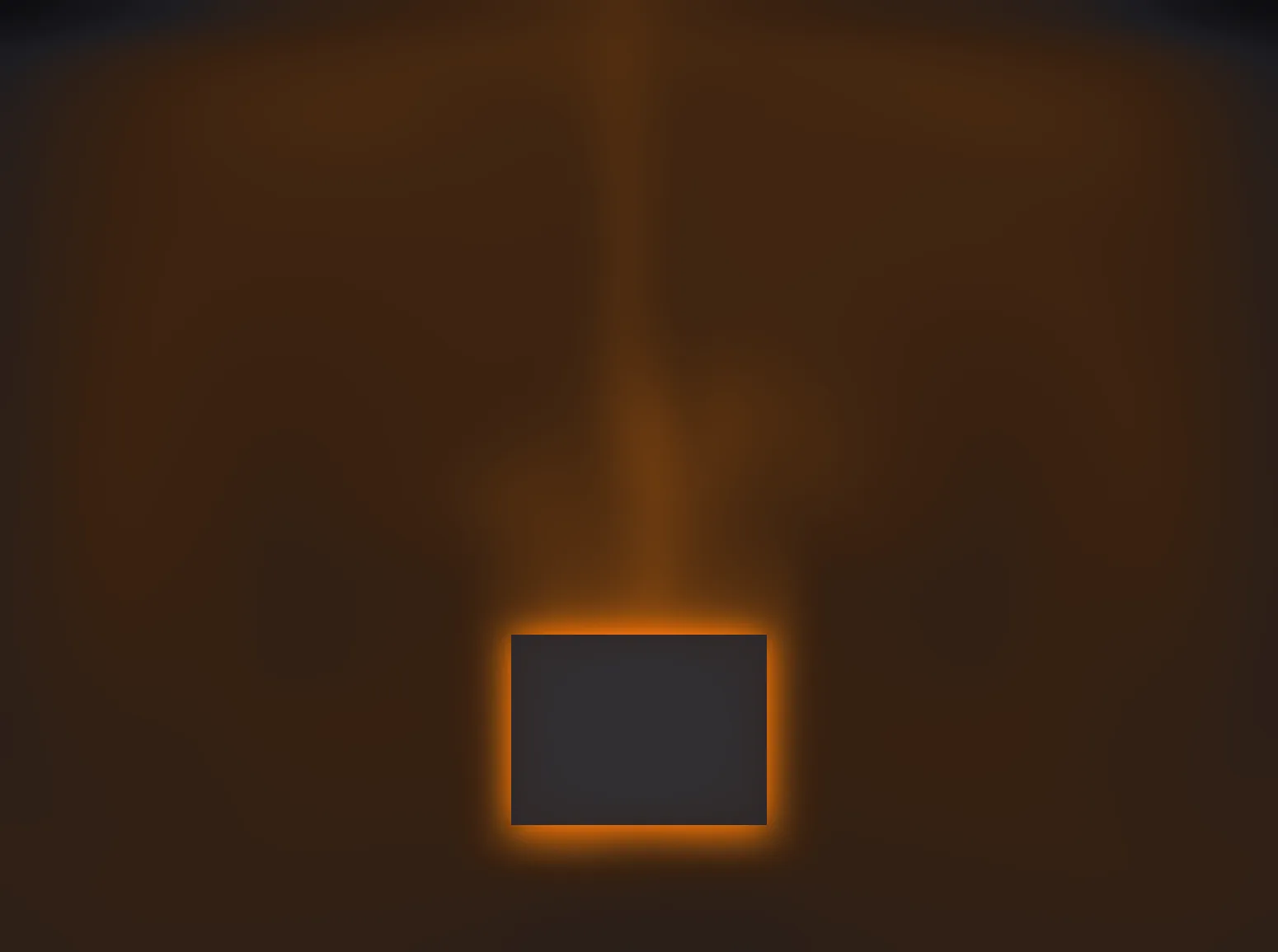
The ask
A 2D section of an immersion-cooling tank: a 400 W server card submerged in a Novec-7100-class fluorocarbon coolant (saturation temperature 61.0 C), with the bulk subcooled by 5 K and a film-condensation plate on the top boundary rejecting heat. Localized nucleate boiling was expected at the card wall. The client wanted a screening verdict gated on two things: card temperature against its 95 C limit, and total vapor inventory — because a little boiling at the wall is the design intent, but a growing vapor blanket is a failure mode.
What the pipeline ran
The Smidr structured finite-volume solver (simforge_fv): incompressible projection on a staggered grid, first-order upwind transport, conjugate heat transfer with per-solid film coefficients, Boussinesq buoyancy, and a Lee-model homogeneous two-phase mixture with a wall-condensation closure, run laminar. The 0.2 m x 0.15 m domain was meshed at 40 x 30 x 1 (1,200 cells; the card spans 6 cells at its smallest feature). The transient ran 6,000 time steps to 58.2 s of physical time (final dt 8.0 ms) in 3.2 s of wall time, then seven automated QA checks — stability, incompressibility, energy balance, resolution, card temperature gate, vapor inventory gate, phase-fraction bounds — evaluated the result and issued the verdict.
The verdict
- All seven automated QA checks passed, so the tool's raw verdict is GO: card peak 71.6 C vs 95 C limit, vapor inventory 0.21% (localized boiling), clean numerics.
- The report itself downgrades that to conditional: steady state was not reached (steady_reached = false), so 71.6 C is an instantaneous value at t = 58.2 s of a still-heating transient — a lower bound on the eventual steady temperature.
- Energy balance closes only to 7.2% (~28.6 W unaccounted), loose but typical of an unconverged transient with active phase change.
- The 1,200-cell grid is coarse for grid-sensitive boiling heat transfer and no mesh-refinement study was run, so the 23.4 K margin carries unquantified discretization error.
Key numbers
| Metric | Value | Note |
|---|---|---|
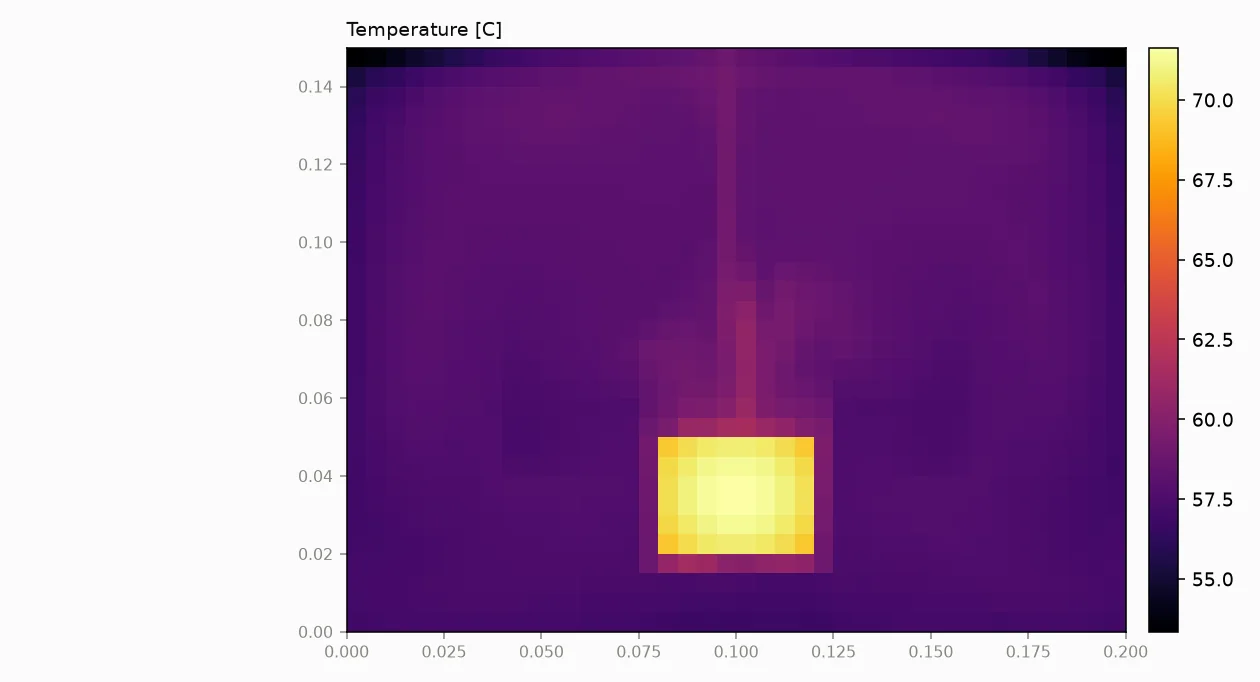
| Card peak temperature | 71.6 C | vs 95 C limit — 23.4 K margin, but taken at t = 58.2 s of a still-heating transient, so treat as a lower bound |
| Heat input | 400 W | volumetric source in the server card |
| Condenser heat rejection | 364.7 W | 91.2% of input through the top condensation plate, plus 6.6 W still going into thermal storage |
| Energy balance error | 7.2% | ~28.6 W unaccounted — passes the check but too loose for fine heat-split claims |
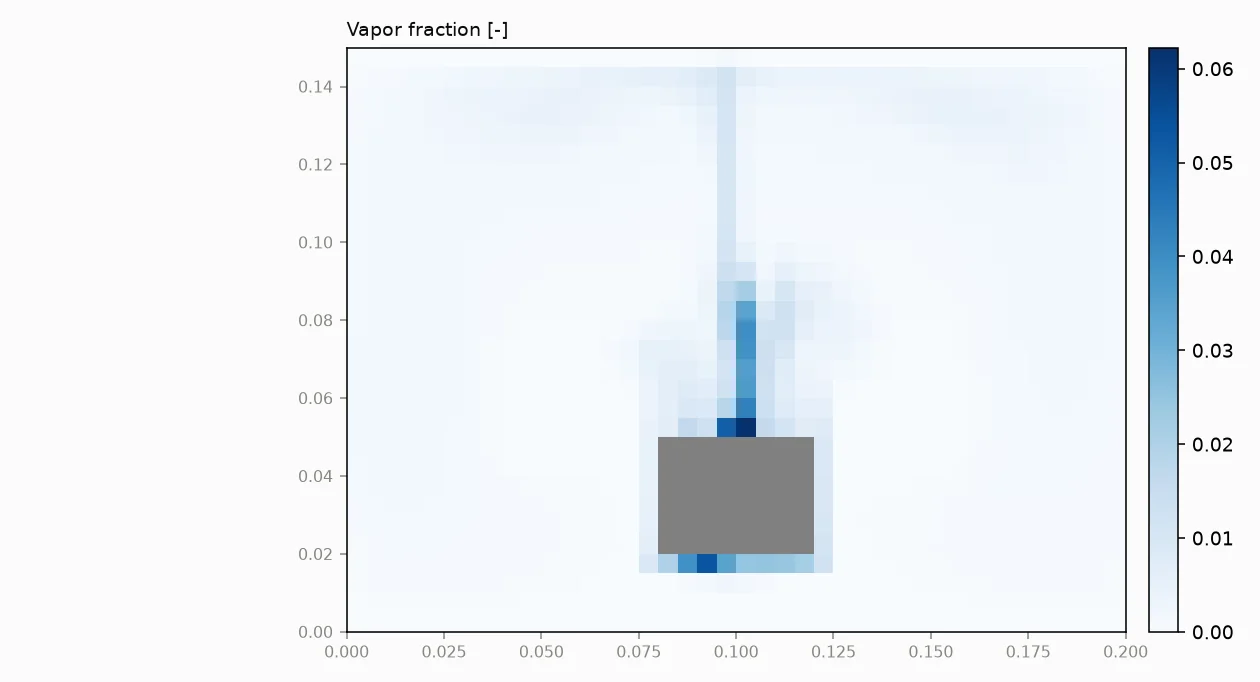
| Peak local vapor fraction | 6.2% | thin near-wall boiling layer at the card; domain-average vapor inventory 0.21% — boiling stays localized |
| Grid | 40 x 30 (1,200 cells) | coarse screening mesh; no refinement study, so discretization error on the margin is unquantified |
| Simulated time | 58.2 s (6,000 steps) | steady_reached = false — the run ended before the tank equilibrated |
| Numerical cleanliness | div 4.2e-15 1/s | post-projection divergence at machine precision; mass balance error exactly zero; vapor-fraction bound violation 6.2e-9 |
| Wall time | 3.2 s | full pipeline including QA checks and report; solver core 2.6 s |
Quality, stated plainly
The pipeline's own report refuses to let the GO stand unqualified. All seven automated checks passed, and the numerics are demonstrably clean — divergence at machine precision, exactly zero mass-balance error, negligible phase-fraction clipping. But the executive summary states plainly that the solution did not reach steady state: 6.6 W is still charging the fluid, the 7.2% energy imbalance is a loose closure typical of an unconverged two-phase transient, and every headline number is an instantaneous snapshot at 58.2 s, not a converged design value. No mesh-refinement study was performed on a quantity — boiling heat transfer — that the report flags as strongly grid-sensitive, and the laminar assumption is challenged in the report itself with a back-of-envelope Re of about 3e4 in the plume. The recommendations are concrete: run to steady state (storage near 0 W, imbalance under 2-3%), refine the mesh at 80x60 and 160x120, add or justify a turbulence model, and extend to 3D worst-case conditions before treating the verdict as design-qualifying.
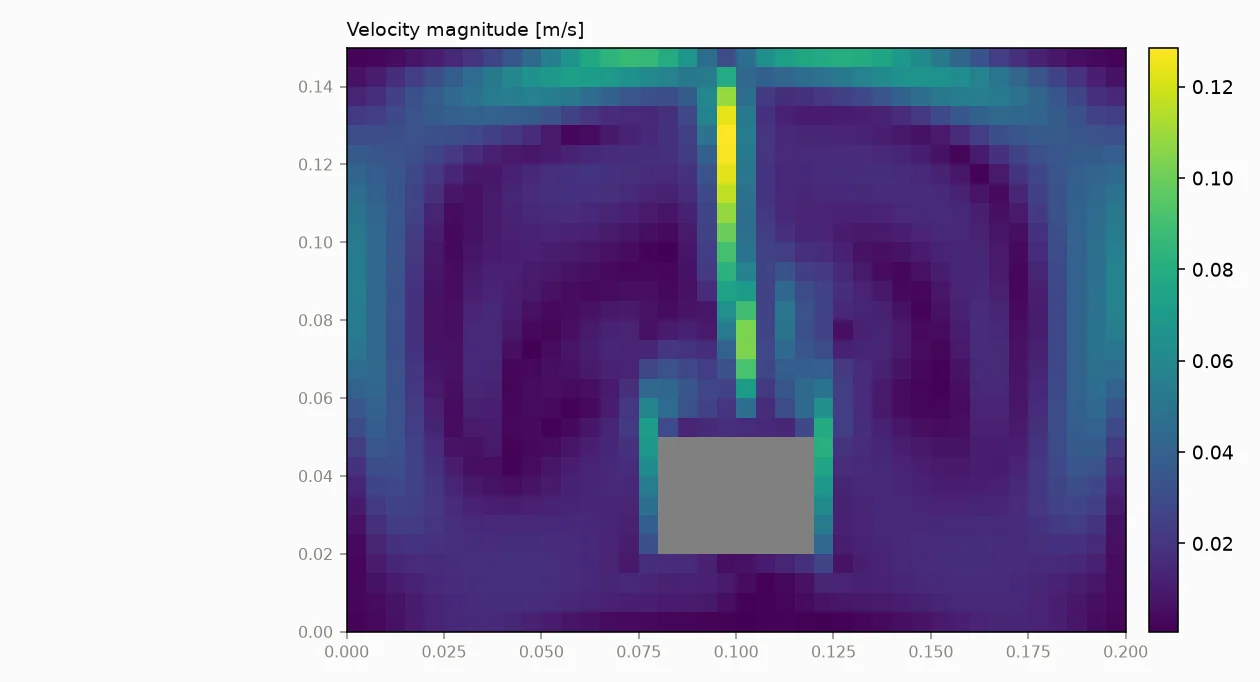
Figures from the run
Why this matters
If you manage engineers, you have seen the failure mode this service is built against: a simulation that reports a comfortable margin without mentioning that the answer never converged. Here the automated gates said GO — and the report immediately told you exactly how far to trust that: the card is 23.4 K under its limit at 58.2 s of a transient that is still heating, on a coarse grid, with the specific re-runs needed to firm the number up. You get the verdict, the margin, the error bars the pipeline could quantify, and a named list of the ones it could not. That is the difference between a tool that sells you a green light and one you can put in front of a design review. The 3-second wall time means the recommended follow-ups — steady-state run, two mesh refinements, sensitivity sweeps — are minutes of compute, not a consulting engagement.
- Steady state not reached: card temperature, vapor inventory, and condenser heat flow are snapshots at 58.2 s of a still-evolving transient — lower bounds, not converged design numbers; the 23.4 K margin may erode with further run time.
- Coarse 1,200-cell grid with no mesh-refinement study; boiling heat transfer and the near-wall thermal boundary layer are strongly grid-sensitive, so the 71.6 C peak carries unquantified discretization error.
- No turbulence model, despite an estimated plume Re around 3e4 (transitional-to-turbulent); the laminar treatment can overstate near-wall superheat while understating bulk mixing.
- 2D section only: no out-of-plane flow, card-to-card interaction, or end effects; the 0.21% vapor inventory says little about margin to a vapor-blanketing / CHF-type regime change.
- Screening fidelity: first-order upwind transport is diffusive (trust integral quantities over fine flow structure), film coefficients are model inputs pending a sensitivity sweep, and the 7.2% energy closure is too loose for fine-grained heat-split claims.
Your part. Your question. Same rigor.
Send us the geometry and the question — get the analysis, the honest error bars, and a verdict you can defend.
Request pilot access